What sticks after the lesson ends: Bare bones teaching, Issue #2

So much of school is designed to get students through something; the unit, the test, the year. But what actually stays with them? In this edition, I reflect on a quiet shift in my teaching: away from delivering answers, and toward helping students build the skills they’ll need long after the lesson is over.
“Learning should not only take us somewhere; it should allow us later to go further more easily.”
- Bruner (1960)
There’s a kind of learning that helps you pass the test. And then there’s a kind of learning that stays with you, quietly shaping the way you think, the way you solve problems, the way you move through the world. The latter tends to be harder to plan for, harder to measure, and harder to teach. But it’s what lasts.
When knowing isn’t enough
In most classrooms, the focus still leans heavily on knowledge. What needs to be covered. What facts belong to the unit. What content aligns with the standards. And for good reason, as there is structure in that. It’s what most teachers were trained for. It’s what most systems reward.
But there’s a growing tension. In a world where knowledge is instantly accessible, summoned with a few taps or a search bar, its value is shifting. What matters now is not just what students know, but what they can do with what they know. Skills like focus, curiosity, reflection, and self-direction aren’t bonus features. They’re essential.
The skills we assume
Despite that, these skills often remain invisible. Students are expected to be focused, but rarely taught how. They’re expected to study, but often left to define what that means on their own. Many interpret it as sitting quietly with a book, until it feels like enough time has passed.
More often than not, students don’t lack effort. They lack strategies. Or language. Or models. And many teachers, including myself, were never shown how to teach those things explicitly. The system still leans toward delivery: content in, answers out.
A small shift in response
One small shift that’s started to take root in my own teaching is in how I respond to questions. When a student asks for an answer, the old reflex is still there, to solve, to provide, to move things along. But more and more, I try to redirect:
“What question are you trying to find the answer for?”
“Where have you read about this before?”
“What have you already tried?”
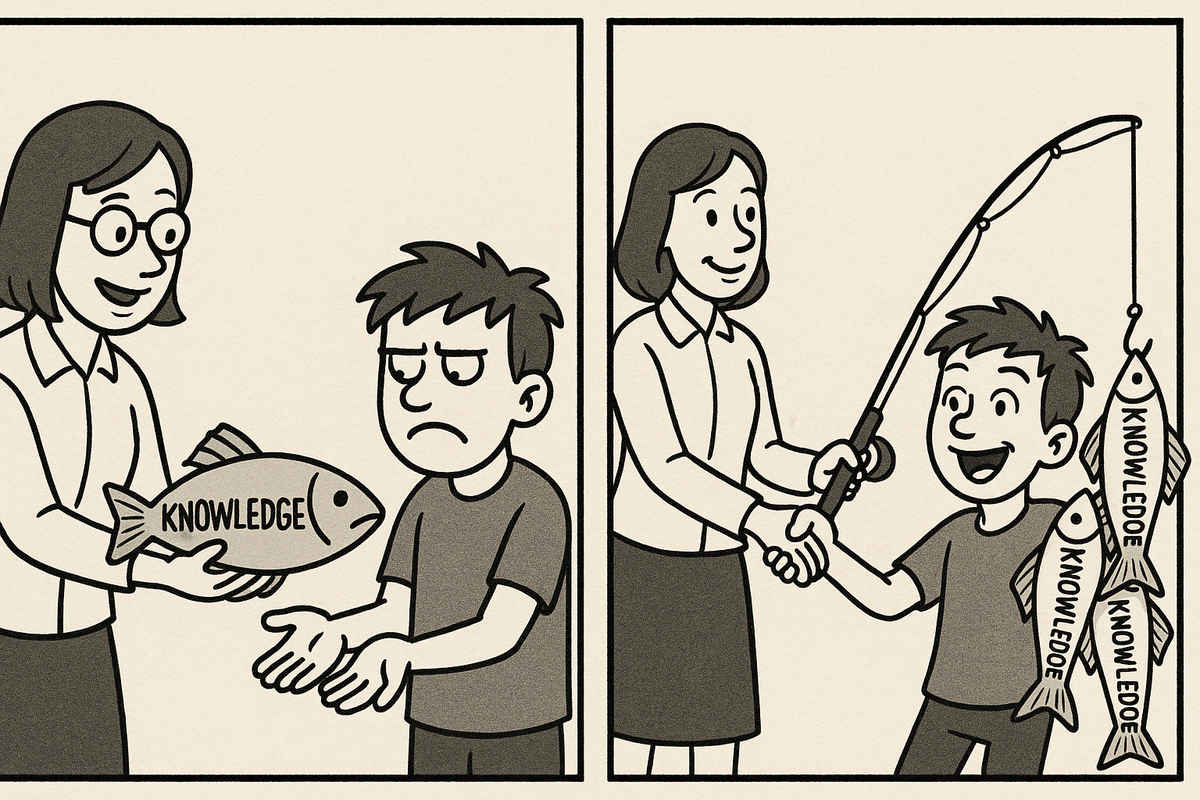
These return questions are simple, but they point to something deeper: an invitation to build skills instead of handing over solutions. It’s not about being vague or unhelpful, it’s about strengthening the thinking process itself.
Planning for what matters
That kind of teaching asks for a different mindset. One that sees knowledge as constructed, not transferred. One that plans backward from what students need to be able to do, not just what they need to know. And one that trusts: if students understand the purpose of what they’re learning, they’ll engage more fully.
The transition from knowledge-based to skills-based teaching isn’t clean. It’s slow, and sometimes unclear. But it starts with noticing. With questioning the routines that feel automatic. With a willingness to shift, even slightly, toward the kind of learning that sticks.
Because helping students go further later on means offering more than just a path to follow. It means helping them learn to build a path of their own.
Until next time,
keep exploring,
keep experimenting,
keep teaching.
~ Bram